
Political organizations today work with more first-party data than ever, but the real advantage comes from how well that data is connected, interpreted, and activated. In 2026, the integration of first‑party data with political data has become one of the most important approaches for organizations seeking to understand audiences better, reduce inefficiencies, and communicate more effectively across channels.
First‑party data provides direct insight into audience behavior: website visits, email engagement, donation activity, volunteer interest, event participation, and other interactions across owned channels. Political data adds the broader context needed to make those signals more meaningful. When these datasets work together, organizations can build stronger audience segments, improve relevance, and create a more reliable foundation for media planning and measurement.
What Is First-Party Data in Political Advertising?
First-party data is the information a campaign collects directly from its own audience. This includes data gathered from campaign websites, email lists, donation pages, petition forms, event registrations, surveys, and volunteer sign-ups.
The value of first-party data in political advertising is that it reveals direct audience behavior. Someone who opens an email, fills out a form, or visits a campaign page is showing interest and intent. That makes first-party data one of the most useful tools for voter engagement, audience segmentation, and campaign personalization.
Common examples of first-party data include:
- Website visits
- Email opens and clicks
- Donation behavior
- Volunteer sign-ups
- Event registrations
- Petition submissions
- Survey responses
Why Political Data Matters for Campaign Targeting
Political data gives campaigns the context they need to turn audience behavior into smarter outreach. It helps teams understand where people fit in the electorate, how to think about voter segmentation, and which audiences are most likely to respond to a message.
For political campaign targeting, this matters because not every engaged user is at the same stage. One voter may be highly active but not yet ready to donate. Another may be a frequent voter in a battleground district and needs a very different message. Political data helps campaigns make those distinctions and activate audiences more strategically.
Political data is especially useful for:
- Voter segmentation
- Persuadable audience targeting
- Battleground and district-level outreach
- Message personalization
- Media efficiency
First-Party Data and Political Data Integration
The strongest political data strategy is not built on one dataset alone. It comes from integrating first-party data with political data in a way that supports targeting, activation, and measurement.
When campaigns connect owned audience data with political audience intelligence, they can identify high-value voter segments, improve campaign segmentation, and reduce media waste. This integration also helps teams build more relevant follow-up audiences based on real engagement behavior.
The benefits of first-party data and political data integration include:
- Better audience targeting
- Smarter voter segmentation
- More efficient media buying
- Stronger personalization
- Improved retargeting
- Cleaner performance measurement
Challenges of Political Data Integration
While the opportunities are significant, several challenges remain:
- Data Quality: Organizations often collect information across multiple platforms, and those records may not be consistent. Duplicate entries, missing fields, and outdated information can weaken the overall dataset.
- Identity Resolution: Matching first‑party records with political or voter‑file data requires accuracy. Weak identity resolution can lead to incomplete or unreliable segments.
- Privacy and Compliance: Political organizations must handle audience data responsibly and ensure that collection, storage, matching, and activation align with current privacy expectations and regulations.
- Attribution and Measurement: Understanding which audiences are responding, and why, remains complex. Clean first‑party data provides a stronger foundation for attribution, but cross‑channel measurement is still evolving.
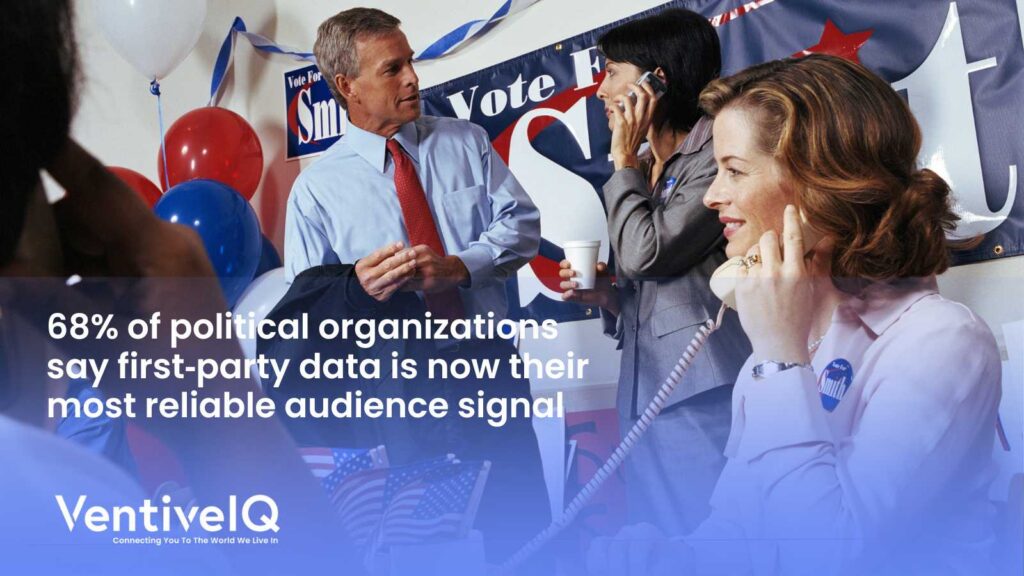
First-party Data
How to Use First-Party Data for Political Campaigns
Campaigns that get the most value from first-party data usually treat it as part of a larger audience strategy rather than a standalone asset. The best approach is to clean the data, organize it properly, and connect it to a political audience framework that supports activation.
To use first-party data effectively in political campaigns:
- Collect data consistently from owned channels
- Clean and standardize records before activation
- Match first-party data with voter and political data
- Build audience segments based on behavior and intent
- Activate audiences across the right media channels
- Test and refine performance over time
This approach helps campaigns focus on the people most likely to respond and spend more efficiently across digital and political media channels.
Why First-Party Data Is More Important in 2026
In 2026, political advertising is more competitive, more expensive, and more data-dependent than ever. Campaigns need to make better decisions with less room for waste. That makes first-party data one of the most valuable assets in political marketing.
The shift away from weaker third-party signals and toward privacy-conscious audience strategies has made first-party data essential for campaign planning. It also gives teams a more reliable way to understand intent, improve audience quality, and support direct voter engagement.
For campaigns that want to improve political ad performance, first-party data is a core part of a modern campaign strategy.
How VentiveIQ Helps Political Campaigns
VentiveIQ helps political teams connect first-party data with audience intelligence and identity resolution so they can build better segments for activation. That is important because the value of campaign data is not just in storing it. The value is in using it to reach the right audiences more effectively.
With VentiveIQ, political campaigns can:
- Improve audience targeting
- Strengthen voter segmentation
- Activate privacy-conscious audiences
- Reduce wasted media spend
- Turn owned data into actionable segments
This makes VentiveIQ especially useful for teams that want to move beyond basic list management and build a smarter, more connected audience strategy.
Our Last Word
First-party data and political data integration are one of the most important opportunities in political advertising today. When campaigns connect owned audience signals with voter and political context, they can improve targeting, increase efficiency, and create more meaningful engagement.
The campaigns that perform best in 2026 will be the ones that know how to turn data into action. That means building clean data systems, improving identity resolution, and activating the right audience at the right time.
For political marketers, the message is simple: better data connections lead to better campaign results.
Build a stronger data strategy for 2026 with VentiveIQ here.